
Fragrances That Smell Like a Luxury Hotel
The Hotel Scent Is Not an Accident
Walk into a well-run luxury hotel and the smell hits you before the check-in desk does. That is not coincidence. Scent marketing has been a serious industry since the early 2000s, with firms like Air Aroma and ScentAir commissioned to create signature diffuser blends for hotel chains, retail flagships and airline lounges. The brief is always broadly the same: clean, warm, woody, and expensive-smelling without being divisive. The result is a category of ambient fragrance that has seeped into mainstream consciousness, training an entire generation to associate certain woody-musky accords with money and arrival.
What the diffuser companies understood early is that smell bypasses judgement faster than any other sense. A lobby can be lit beautifully and furnished impeccably, but a scent that reads wrong will undercut all of it within three seconds of entering. The most successful hotel scents therefore work in the negative space: they do not call attention to themselves, they simply make a room feel like the kind of place you want to stay in. Woody-amber and clean-musk accords dominate that brief because they read as warmth and care without reading as perfume. They also age gracefully in a diffuser, which cheap florals and citrus accords do not.
Personal fragrance caught up fast. A handful of niche and designer releases found a second life as the scent you wear to recreate that feeling, and a few of them became so associated with that mood that they now define it. Santal 33 is the obvious example, a fragrance so widely diffused in boutique hotels and concept stores that it became shorthand for a certain kind of curated, aesthetic-forward hospitality. Baccarat Rouge 540 earned a similar reputation — you will find a full list of its Baccarat Rouge 540 alternatives if you want that angle, but it is not pinned here because the hotel-lobby brief suits a narrower, more personal-wear selection.
The three fragrances below cover the spectrum from dry American-West sandalwood to green-and-rainy European cool to Parisian apartment warmth. All three are stocked across the retailers we track, with live lowest and average prices in the cards.
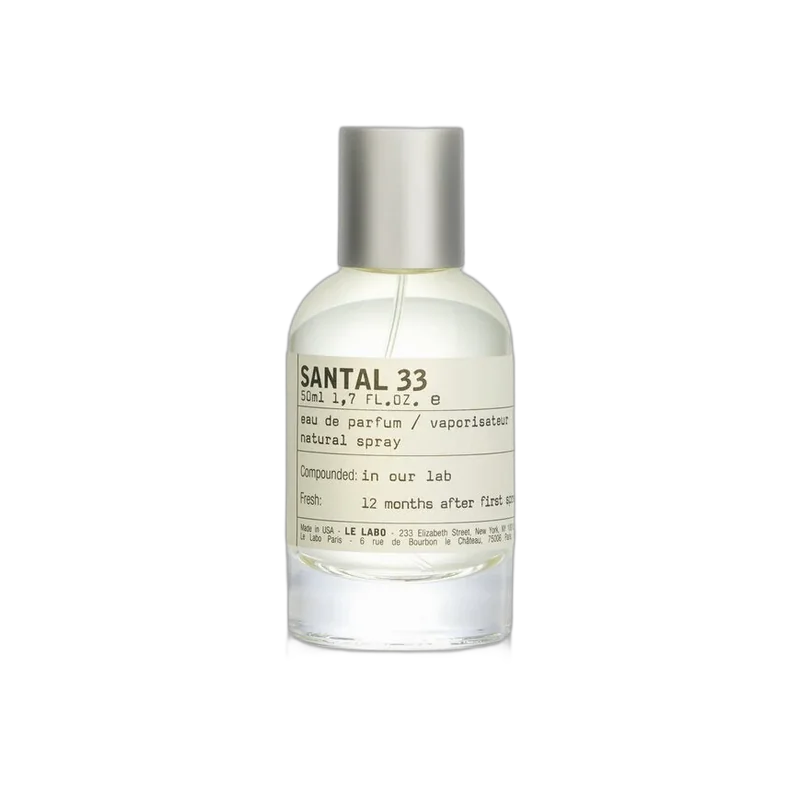
Santal 33 Eau De Parfum
Released in 2011, Santal 33 is the fragrance that made Le Labo a household name and became the unofficial scent of every boutique hotel, third-wave café and members club from Brooklyn to Bondi. The concept is a romanticised American West rendered through a woody-musky accord anchored by sandalwood and cardamom: pencil shavings, saddle leather and open prairie, with violet and iris adding a powdery, almost cosmetic layer beneath. What made it inescapable is the way it smells simultaneously like clean skin and like something that costs a lot of money. There is no sweetness, no fruit, no obvious crowd-pleaser. It just radiates a dry, woody warmth that reads expensive in a room. Projection is moderate and longevity is solid, running six to eight hours on most skin, though the formula rewards layering with the matching body wash. It wears convincingly on all genders and has been worn so ubiquitously that you either love it or have complicated feelings about it. The saturation is real, and so is the quality that caused it. If you want to know what a certain kind of curated boutique hotel smells like, this is the answer — and it remains the most influential single release in the modern sandalwood genre.
The Scent That Conquered Every Boutique Hotel
Santal 33's cultural ubiquity can make it easy to dismiss, but it is worth understanding why it spread so far so fast. The formula solved a problem that most fragrances do not: it smells expensive in the air, not just on skin. Most perfumes that project impressively do so sweetly or heavily, which is divisive in shared spaces. Santal 33 projects a dry, woody warmth that triggers the expensive-hotel association without reading as perfume in the room-filling sense. That made it ideal for both diffusion and personal wear, and the gap between the two blurred quickly.
It is also genuinely well-constructed. The pencil-shavings and iris give it a slight cosmetic quality that smooths over what could otherwise be an austere scent, and the cardamom brings just enough warmth to make it wearable in any season. It is not a comfortable scent in the way a soft musk is comfortable; it is more like wearing a very good leather jacket, slightly imposing and entirely intentional.
A decade and a half on, its saturation has become part of its identity. Enthusiasts debate whether that association is a liability or simply evidence of how well the formula works. The honest answer is both: ubiquity means you will smell it on other people, but that same ubiquity is proof that it delivers on a brief that almost no other fragrance does as cleanly. It remains the most direct personal-wear translation of the boutique-hotel smell, and for the curious, the broader best sandalwood fragrances list shows how much range the sandalwood category has beyond this one release.
The Quieter Sibling
Baie 19 occupies a different register: cooler, greener and less recognisable to a room. If Santal 33 announces itself, Baie 19 is the version you wear when you want the mood without the association. The green-berry-leaf accord at its core is unusual in the Le Labo range and gives it a character that the brand's other woody scents do not share. It is harder to place, which is part of its appeal, and it suits warmer months and daytime wear better than the original.
There is something in Baie 19's palette that calls to mind a particular kind of hotel: the high-ceilinged, garden-facing room where the windows are open and the air is cool. It does not smell like a lobby product. It smells like a place where someone opened a window, which is a harder thing to manufacture and, arguably, a more interesting brief. The lighter projection is a feature rather than a weakness here; it is designed to suggest rather than announce.
The two work well as a pair precisely because they are not interchangeable. Santal 33 for autumn and winter, Baie 19 for spring and the kind of summer hotel where the air conditioning is always running. Both are well stocked here and both can be found at live prices through the retailers we track.
Something More Interior
34 Boulevard Saint Germain sits apart from the Le Labo pair in every sense. Diptyque's approach to fragrance has always been more literary and less trend-aware than the niche mainstream, and this release reflects that. Where Santal 33 sketches an idealised American landscape seen through a hotel lobby, the Diptyque is entirely interior — a building, a room, a particular quality of afternoon light through old curtains.
The house's candle heritage shows here in an interesting way. Diptyque built its reputation on candles that smelled of real things — a fireplace, roses left in a vase, an old library — rather than abstract perfume accords, and 34 Boulevard Saint Germain carries that same philosophy into personal fragrance. The benzoin and beeswax that anchor it are the same materials that make a candle smell expensive, and on skin they create that same sense of warmth settling into a room.
It is the right choice if the sandalwood-leather axis of the Le Labo scents does not suit you, or if you want something that reads as personal rather than recognisable. The fig, rose and beeswax combination is specific enough that you are unlikely to smell it on anyone else. That specificity is increasingly valuable in an era when certain woody-amber accords have become almost universal; a fragrance that cannot be easily categorised is harder to copy and harder to dilute by association. Among fragrances that smell expensive without relying on crowd familiarity, this one earns its place.
How to Choose
Start by deciding what kind of hotel experience you are actually after. If you want the lobby effect — the scent that reads expensive in a room and that people will place even if they cannot name it — Santal 33 is the direct answer. It is the most projecting of the three, the most culturally legible, and the one that most closely mirrors what a scent diffuser company would choose for a boutique property. That legibility is both its strength and its only real drawback.
If you find Santal 33 too familiar or too heavy for the months when sandalwood-and-leather feels like too much weight, Baie 19 gives you the same house's sensibility applied to a completely different mood. It is quieter, cooler and less recognisable — and in a world where Santal 33 has become almost ambient background noise in certain cities, that relative obscurity has real appeal. It suits warm weather and daytime wear in a way the original does not.
If you want something that smells more personal than cultural — a fragrance that rewards proximity rather than broadcasting across a room — 34 Boulevard Saint Germain is the considered pick. It is also the most distinctly European of the three, which suits the apartment-in-Paris brief better than the other two could manage.
On value, all three sit in the niche-to-premium bracket. Live prices through the retailers we track vary enough that comparing before you buy is worthwhile, especially on the Le Labo bottles, which are stocked by enough retailers to show a meaningful spread. The Diptyque is similarly well represented. Checking live data before committing to a full bottle is the straightforward move.
Compare hotel-scent fragrance prices across every retailer on Aurexum