
Why Does Perfume Smell Different on Me?
The Short Answer
Yes, perfume genuinely smells different on you than it does on someone else, and the reasons split cleanly into two halves. Half of it is your skin: pH, oiliness, temperature, hydration, diet and even medication change how fast fragrance materials evaporate and which ones dominate. The other half is your nose, which filters what you can perceive and, for certain molecules, may not perceive them at all.
Most people assume the bottle is a fixed thing and the wearer is neutral. It is closer to the opposite. A fragrance is a set of volatile materials that need heat and a surface to unfold, and your skin is that surface. Change the surface and you change the result. This is why a scent you loved on a friend can fall flat on your wrist, and why two people can argue in good faith about whether something is loud or barely there.
What Your Skin Actually Does
The single biggest variable is oil. Oily skin holds fragrance materials longer and slows their evaporation, so scents tend to last longer and smell richer and sweeter on it. Dry skin does the reverse, burning through the volatile top notes quickly and often making a fragrance feel thin or short-lived. If a perfume seems to disappear on you within an hour, dryness is usually the culprit, and moisturising first with an unscented lotion genuinely helps by giving the oils something to cling to.
Skin pH matters too. Human skin is mildly acidic, but the exact level varies from person to person and shifts with sweat, washing and hormones. More acidic skin can sour or sharpen certain notes, while others turn warmer and sweeter. Temperature plays its own part, because volatile materials evaporate faster off warm skin, which is why the same fragrance projects harder in summer and on people who simply run hot.
Then there is everything you put into your body. Diet leaves traces on skin chemistry, and strongly flavoured foods, alcohol and spices can nudge how a scent reads. Some medications alter skin oil or sweat composition enough to shift a fragrance noticeably. None of this is mystical. It is just chemistry meeting a surface that is quietly different on every person.
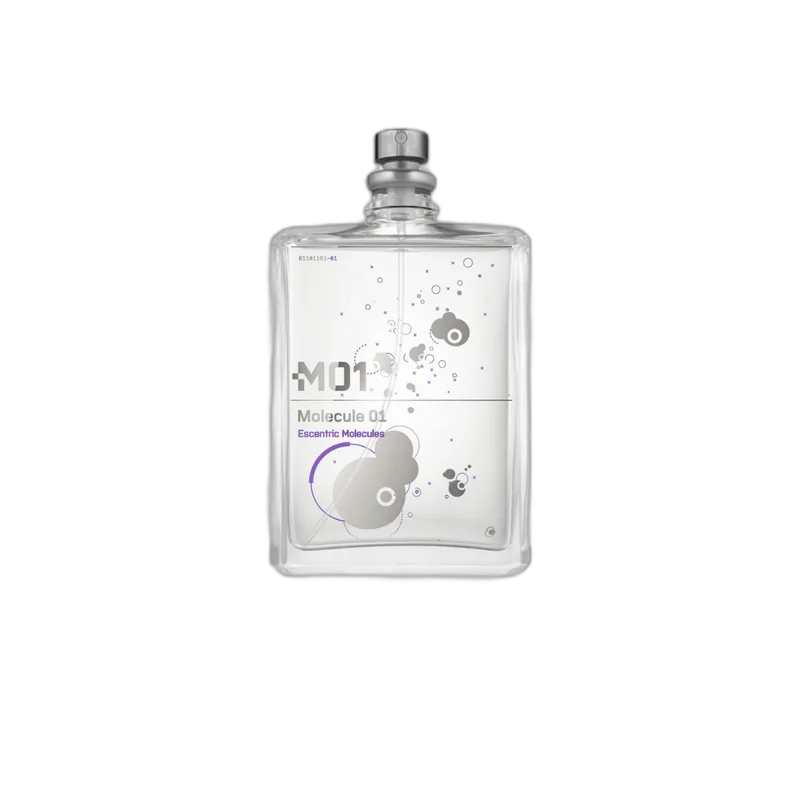
Molecule 01
Geza Schoen's 2006 experiment, made for his own Berlin house Escentric Molecules and the reason single-molecule perfume became a genre. Molecule 01 is one material and nothing else, Iso E Super, a warm woody-ambery synthetic that smells faintly of cedar, velvet and skin without ever resolving into a clear picture. That refusal to sit still is the whole point. On some wearers it reads loud and creamy, on others it seems to vanish within the hour and then drift back an afternoon later, which is exactly the disappearing-and-reappearing act that made it a cult object. Part of that is the molecule, which lingers on skin below many people's threshold, and part is that Iso E Super triggers selective anosmia, so a fraction of noses simply cannot detect it. It projects softly and works as a second-skin scent rather than a statement, unisex by design and famously flattering under other fragrances as a booster. The plain apothecary bottle matches the stripped-back idea. If you have ever wondered whether a scent can genuinely behave differently on you than on a friend, this is the clearest possible test case.
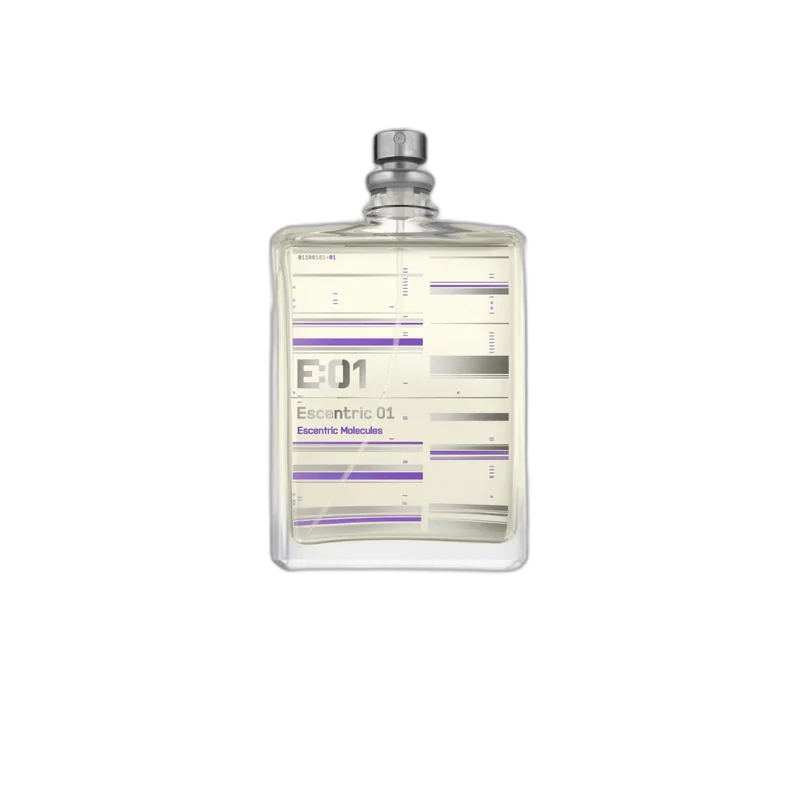
Escentric 01
The dressed-up twin of Molecule 01, released the same year by Geza Schoen for Escentric Molecules and built around the same Iso E Super at its centre. Where Molecule 01 is the raw material alone, Escentric 01 surrounds it with a proper composition, so lime, pink pepper and ginger lift the open before balsamic incense, musk and a little cedar settle around that woody-ambery core. The effect is fuller and easier to read as a conventional perfume, though it still trades on the strange half-there quality of the molecule underneath. Because so much of the base sits near the edge of perception, it wears very differently person to person, warm and close on some skin, almost transparent on others. That variability is a feature here, not a flaw. It projects moderately and lasts a solid stretch on skin, more present than its stark sibling without ever shouting. Unisex and understated, it suits people who like the Molecule concept but want something with more shape around it. As a case study in how the same material can hide or bloom depending on the wearer, the pair is hard to beat.
The two Escentric Molecules bottles above are the clearest way to see skin chemistry in action. Both are built around Iso E Super, a woody-ambery synthetic that behaves unusually on skin, and both are famous for the disappearing act that gives this post its title. Molecule 01 is the material almost naked, which is why its behaviour swings so wildly between wearers. Escentric 01 dresses the same molecule in lime, pepper and incense, and even that fuller version still hides or blooms depending on whose skin it lands on. The core material here is worth understanding on its own terms, which we cover in what is ambroxan, the sibling synthetic that shows up in half the fragrances accused of vanishing.
Selective Anosmia, or Why Reviews Disagree
Skin is only half the story. The other half is that not everyone smells the same molecules, and this is the part most people have never heard of.
Selective anosmia means being unable to detect one specific compound while smelling everything else normally. It is common with musks and with woody-ambery synthetics like Iso E Super and ambroxan. A meaningful fraction of the population simply cannot perceive certain of these materials at all, and many more can smell them but only faintly. This is why the disappearing-perfume complaint clusters so tightly around exactly these ingredients.
It also explains why fragrance reviews contradict each other so violently. When one person calls a scent a beast that clears a room and another calls it a skin scent that dies in twenty minutes, they may both be telling the truth about their own noses. If a fragrance leans heavily on a musk or an ambery synthetic you happen to be anosmic to, you will experience it as weak or empty while the person beside you is overwhelmed. Neither of you is wrong, and neither bottle is faulty.
Nose-Blindness to Your Own Scent
There is a second perception trap, and this one catches everyone. Your nose adapts to a constant smell and stops reporting it, a process called olfactory habituation. Within minutes of applying a fragrance you are wearing every day, you largely stop noticing it, even though it is still clearly present to people around you.
This is why so many people conclude their perfume has no longevity when it has plenty. You are not smelling less scent, you are smelling the same scent and tuning it out. It is also why the urge to overapply is so strong and so worth resisting, because chasing a smell you have gone nose-blind to is how you end up as the person announced by their fragrance before they enter a room. If you want to check whether your scent is really gone, ask someone else, or leave the room and come back after ten minutes and catch it fresh.
Why Paper Strips Lie
Blotter strips are useful for one thing, sampling a lot of fragrances quickly to sort the maybes from the definitely-nots. They are close to useless for deciding whether you will actually enjoy wearing something. Paper has no oil, no warmth and no pH, so it delivers a flat, mostly top-note impression that skips everything that makes a fragrance yours.
A scent on paper is missing the entire second half of the equation described above. The drydown, where most perfumes spend most of their life, depends on skin heat and skin oils to develop, and those are exactly what paper lacks. Something can smell forgettable on a strip and lovely on your wrist, or dazzling on a strip and disappointing once your skin gets hold of it. Judge on paper and you are judging a different product from the one you will wear.
The Maison Francis Kurkdjian bottle above is the tidiest proof that a formula is not a smell. Gentle Fluidity Silver and its Gold twin share an identical ingredient list and diverge only in dosing, yet they read as opposite characters, one cool and spirit-like, the other warm and sweet. If a single perfumer can make one material list smell like two different people just by changing proportions, it should be no surprise that your skin does the same thing to whatever you spray on it. The lesson is the same one every experienced buyer learns eventually, and it runs through our guide to how to sample fragrances: the only surface that tells you the truth is your own.
How to Test a Fragrance Properly
Once you accept that skin and nose both intervene, the right way to test becomes obvious. Spray it on skin, not paper, and give it a real wrist or forearm rather than a fleeting sniff. Wear one fragrance at a time so you are not confusing yourself with three competing scents, and resist the urge to layer while you are still learning what a bottle does on its own.
Then wait. The first ten minutes are the alcohol flash and the loudest top notes, and they are the least representative part of the wear. Judge a fragrance at the drydown, an hour or two in, because that is what you will smell for most of the day and what other people will mostly encounter. If you can, live with it across a full day and in the weather you would actually wear it in, since heat and cold change everything.
Finally, reset your nose between tries. When everything starts smelling the same, that is habituation setting in, and the fix is fresh air or a sniff of your own arm rather than another blotter. Rotate the scents you own rather than wearing one into the ground, both to keep your nose responsive and to stop going blind to a favourite. Skin-close, quiet fragrances reward this patience most of all, which is partly why we treat them as their own category in our roundup of the best skin scents.
The Practical Takeaway
If a fragrance smells different on you than in the bottle, on a strip, or on a friend, nothing is broken. Your skin is doing what everyone's skin does, and your nose is filtering the way every nose filters. The useful conclusions are small and concrete. Buy after testing on your own skin, not after a shop-counter sniff or a review. Judge at the drydown, moisturise if scents die fast on you, and never trust your own nose on a fragrance you wear daily, because it stopped reporting that one a while ago.
The Molecule 01 wearers who swear it vanishes and the ones who get compliments all day are both right, and that contradiction is the clearest window there is into how personal this all is.