
Fragrance Notes Explained: Top, Heart and Base
What Fragrance Notes Actually Are
Fragrance notes are the individual smells you pick out of a perfume as it dries on your skin, traditionally sorted into three tiers by how quickly each material evaporates: top notes in the first fifteen minutes or so, heart notes across the next few hours, and base notes in the long tail that can last most of a day. A perfume is a blend of dozens of ingredients released all at once, but you do not perceive them all at once, because lighter molecules lift off first and heavier ones cling to the skin far longer. That staggered release is the whole idea behind the pyramid, and it is why the same bottle can smell like citrus at the counter and like something else entirely by the time you get home.
Understanding this does two useful things. It stops you rejecting a fragrance in the first two minutes when you have only smelled its top, and it lets you read a note list on a retailer page and predict, roughly, how a scent will behave through the day rather than just what its opening advertises.
The Pyramid and Why It Exists
The fragrance pyramid is not a marketing invention, even if marketing loves it. It is a rough map of volatility. Volatility just means how readily a material turns from liquid to vapour, and lighter, smaller molecules do that faster. Citrus oils, most green and herbal materials and many synthetics are volatile, so they flash off early and form the top. Florals, spices and fruits tend to sit in the middle range and become the heart. Resins, woods, musks, ambers and heavy materials like vanilla, oud and patchouli are the least volatile, so they linger and form the base.
Perfumers build with this in mind deliberately. The top is designed to sell the scent in the first sniff and then get out of the way. The heart is the character most people think of as the fragrance itself, the part that dominates the middle of the wear. The base is the foundation everything rests on, and it does two jobs at once: it provides the lasting drydown and it acts as a fixative, slowing the evaporation of the lighter materials above it so the whole composition holds together longer than it otherwise would.
None of the boundaries are sharp. Notes overlap and bleed into each other, and a well-made fragrance transitions rather than switching cleanly between stages. The pyramid is a model, not a law, but it is a genuinely useful one for a beginner learning to read what is in the bottle.
A Pyramid in Real Time
The fastest way to understand any of this is to wear something with a textbook arc and pay attention. Guerlain Habit Rouge is close to the ideal teaching piece, because Jean-Paul Guerlain built it in 1965 as a classic three-act structure you can follow on skin almost like a demonstration.
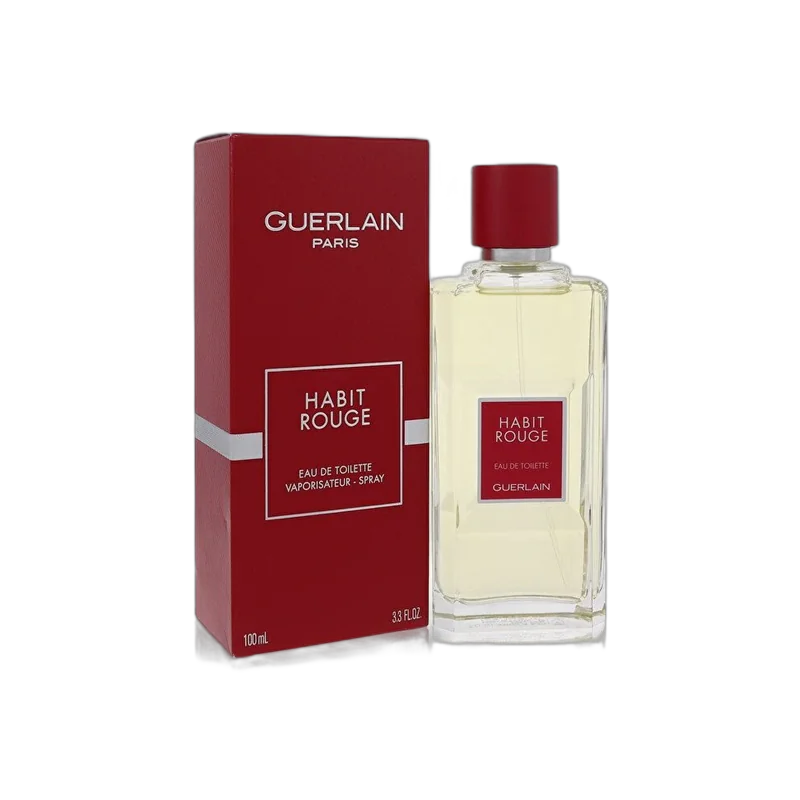
Habit Rouge Eau De Toilette
Guerlain's 1965 leather-vanilla landmark, composed in-house by Jean-Paul Guerlain, and about the clearest demonstration of a fragrance pyramid you can wear on your own arm. Habit Rouge opens loud and bright on citrus, a burst of orange, bergamot and lemon so sharp it can read almost like cologne for the first few minutes. That top fades fast, exactly as the volatile citrus oils are meant to, and hands over to a spiced floral heart of carnation, rose and cinnamon that carries the middle stretch of the wear. Then the long tail arrives and the whole thing changes character, settling into the powdery leather, benzoin and vanilla base that gives the scent its name and its reputation. The name translates as the red riding coat — a formal equestrian dress — and the Guerlinade signature that Jean-Paul Guerlain wove through it anchors the drydown in powdery warmth. It leans classic masculine but wears close to unisex now, projecting well early then softening to a skin-scent hum that lasts most of a day. As a teaching bottle it is hard to beat, because you can follow every layer arriving and leaving on schedule.
Spray it and start the clock. For the first fifteen minutes you get a loud citrus top, all orange and bergamot and lemon, so bright it can read like a splash of cologne. That is the volatile fraction doing exactly what volatile materials do, burning off fast. Come back at the half-hour mark and the citrus has thinned right out, replaced by a spiced floral heart of carnation, rose and cinnamon that will run for the next few hours. This is the middle of the pyramid, the part most people would describe as the scent's actual personality. Wait a few hours more and the character shifts again as the base takes over, a powdery leather laced with benzoin and vanilla that gives Habit Rouge its name and settles into a warm skin scent lasting most of the day.
Wear it once with a bit of attention and the abstract diagram becomes obvious. You have physically felt the top leave, the heart hold and the base arrive, on your own arm, on roughly the schedule the model predicts. Very few fragrances lay their structure out this legibly, which is exactly why it makes such a good first lesson.
When Fragrances Break the Model
Not every scent behaves like a tidy three-stage pyramid, and plenty of modern releases break the model on purpose. The industry term for these is linear fragrances, and they smell more or less the same from the first spray to the last dry hour, with little of the top-to-base transformation Habit Rouge puts on display.
This is often a deliberate design choice rather than a flaw. Many contemporary bestsellers are built around a big, stable synthetic backbone that projects hard and stays put, so the fragrance you smell in the shop is close to the fragrance you go to bed in. Materials like ambroxan are a large part of why: ambroxan is powerful, tenacious and sits fairly steady through the wear, so a composition leaning on it tends to flatten the usual arc. If you want the detail on that single molecule and why it dominates so many current releases, we cover it in what is ambroxan. Linearity is not automatically worse than a dynamic pyramid, it is just a different intention. Some people prefer the reliability of knowing exactly what they will smell like all day, and others find that predictability boring next to a scent that genuinely evolves. Neither camp is wrong.
Concentration plays into how much transformation you get, too. A stronger concentration usually holds its shape and lasts longer, which affects how clearly you experience the stages, and we unpack that in EDT vs EDP explained.
Notes Are Marketing, Not Ingredients
Here is the part that trips up most beginners. A note list is not an ingredient list. It is a description of what a fragrance smells like, written to be evocative, and it often has only a loose relationship to what is physically in the bottle.
A single listed note can be one raw material or an accord built from thirty. When a pyramid says "leather", there is almost never leather in it; leather is a smell recreated from an accord of birch tar, castoreum substitutes, isobutyl quinoline and other materials. The same goes for most fruit, for oceanic and "marine" notes, and for anything that could not survive being distilled, like lily of the valley or peony, which are reconstructed entirely from synthetics. Conversely, some of the most important materials in a formula never appear on the list at all, because musks, ambers and fixatives are structural rather than headline-worthy and rarely make good copy.
Note lists are also chosen to sell. Houses foreground the pretty, aspirational materials and quietly omit the workhorses, and two brands can describe near-identical accords with completely different words. So treat the pyramid on a product page as a rough sketch of the intended mood and family, not a recipe. It tells you what the perfumer wants you to imagine, which is genuinely useful information, as long as you do not mistake it for a full parts list.
How to Actually Shop With Note Lists
Once you stop reading note lists as literal ingredients, they become a practical shopping tool. The trick is to look for patterns rather than poetry.
Start with the family. Whether something sits in the citrus, woody, floral, gourmand, chypre or fougère camp tells you more about how it will wear than any single lyrical note does, and grouping by family is the fastest way to find scents adjacent to one you already like. We break the main groups down in fragrance families explained, and it is the first thing worth learning to read.
Next, anchor on materials you actually know from experience. If you have worn and loved a particular vanilla, a specific rose or a smoky incense, look for that material appearing in the heart or base of something new, because that is where it will define the wear rather than flash off in the opening. Our best vanilla fragrances and best citrus fragrances guides are built exactly this way, sorted by how the hero material behaves on skin.
Then read positionally. Materials listed at the base tell you the drydown, the part you will live in for hours, so weight those more heavily than the flashy top. Ignore the adjectives entirely and just count the materials. And remember the list says nothing about strength or trail. For that, a note pyramid is useless, and you want projection and longevity explained instead, which covers how far a scent throws and how long it lasts, the two things a note list will never tell you.
Do that and a note list stops being decoration. You read the family, spot the materials you trust, weight the base over the top, and you can predict roughly how a bottle will wear before you have smelled it, which is exactly what makes shopping online for fragrance possible at all.